
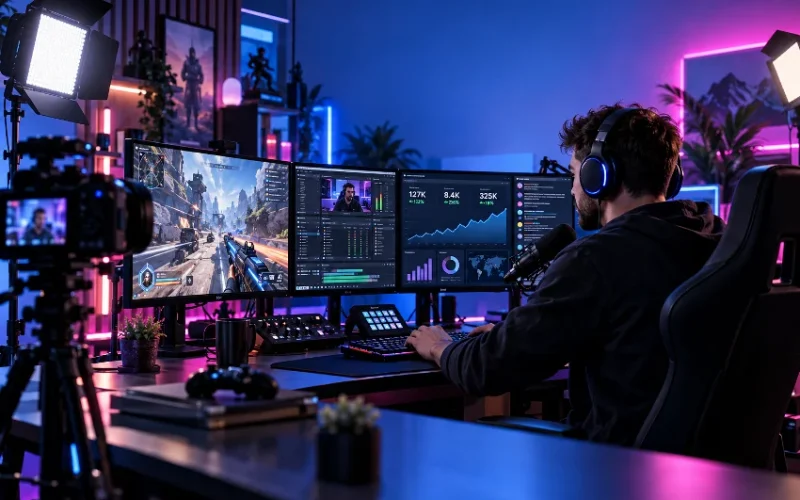
Modern Gaming Video Production combines technical recording skills, creative storytelling, live streaming technology, and audience development.
Successful creators understand that impressive graphics alone aren’t enough. Viewers expect entertaining gameplay, clear audio, engaging editing, and content that respects their time.
Learning how these elements work together can transform occasional uploads into a professional, scalable content operation.
1. Understanding Advanced Gaming Video Production
Gaming content creation has evolved far beyond recording gameplay and uploading unedited footage.
Professional creators now operate much like small digital production studios, combining entertainment, technical engineering, audience research, and marketing.
The most effective approach connects these disciplines through a consistent production workflow.
Building a Strategic Gaming Content Framework
Before recording anything, creators should understand exactly who they want to reach.
Competitive players might prefer advanced tutorials, mechanical breakdowns, and ranked gameplay analysis. Casual audiences may respond better to entertaining challenges, funny moments, and personality-driven storytelling.
These differences influence video length, editing style, commentary, and publishing frequency.
A creator specialising in competitive shooters, for example, could develop several complementary formats around a single game.
Long-form strategy guides might explain positioning and decision-making, while shorter videos highlight practical techniques. Live broadcasts could then demonstrate those ideas during real matches.
This creates a connected content ecosystem rather than a collection of unrelated uploads.
Defining Production Quality Standards
Professional production doesn’t necessarily require the most expensive equipment.
Instead, it requires consistent standards for visual clarity, audio quality, editing, and presentation.
Creators should establish appropriate recording resolutions, stable frame rates, microphone settings, and export specifications.
A technically demanding game may look better when recorded at a stable 1080p60 than at an unstable higher resolution.
Consistency matters because viewers can become distracted by frame drops, distorted commentary, or rapidly changing audio levels.
Production quality should support the gaming experience rather than compete with it.
2. Advanced Gameplay Recording and Capture Technology
Capturing gameplay efficiently requires understanding how recording software interacts with gaming hardware.
Games already demand significant processing resources, and additional recording workloads can reduce performance when poorly configured.
A professional setup balances recording quality with system stability.
Choosing the Right Recording Architecture
PC gaming creators commonly use software-based capture systems such as OBS Studio, while console creators may use internal recording features or dedicated capture devices.
OBS supports multiple sources, including game windows, webcams, microphones, and graphical overlays.
Its configuration options allow creators to adapt recording workflows to different hardware environments.
For example, a creator using a powerful graphics card may benefit from supported hardware encoding.
This can reduce reliance on CPU-based video encoding, although actual performance depends on the hardware, encoder settings, and game workload.
A separate recording computer may be useful for certain professional setups, but it isn’t essential for producing high-quality gaming videos.
Resolution, Frame Rate, and Bitrate Optimisation
Three technical factors strongly influence recorded video quality: resolution, frame rate, and bitrate.
Resolution determines the number of pixels in the image, while frame rate describes how frequently new frames appear.
Bitrate influences how much information is available to represent the video.
Fast-paced games with frequent camera movement generally require more encoding resources than relatively static content.
YouTube’s recommended SDR upload bitrates provide useful export references.
| Video Format | Recommended Upload Bitrate |
|---|---|
| 1080p at 30 FPS | 8 Mbps |
| 1080p at 60 FPS | 12 Mbps |
| 1440p at 30 FPS | 16 Mbps |
| 1440p at 60 FPS | 24 Mbps |
| 4K at 30 FPS | 35–45 Mbps |
| 4K at 60 FPS | 53–68 Mbps |
These are YouTube upload recommendations for SDR video, not universal recording settings or livestream bitrates.
Creators may need higher-quality intermediate recordings for editing, especially when applying detailed colour adjustments or effects.
Recording Formats and Storage Reliability
Long gaming sessions can produce substantial video files, making recording format and storage management important.
OBS recommends MKV recording because it is more resilient when a recording ends unexpectedly.
Finished files can subsequently be remuxed into compatible formats when required by editing software.
Creators should also estimate storage requirements before recording major sessions.
For example, a recording averaging 50 Mbps produces approximately 22.5 GB of video data per hour, excluding additional audio and container overhead.
Maintaining sufficient free storage and reliable backup procedures reduces the risk of losing valuable footage.
3. Professional Audio Engineering for Gaming Content
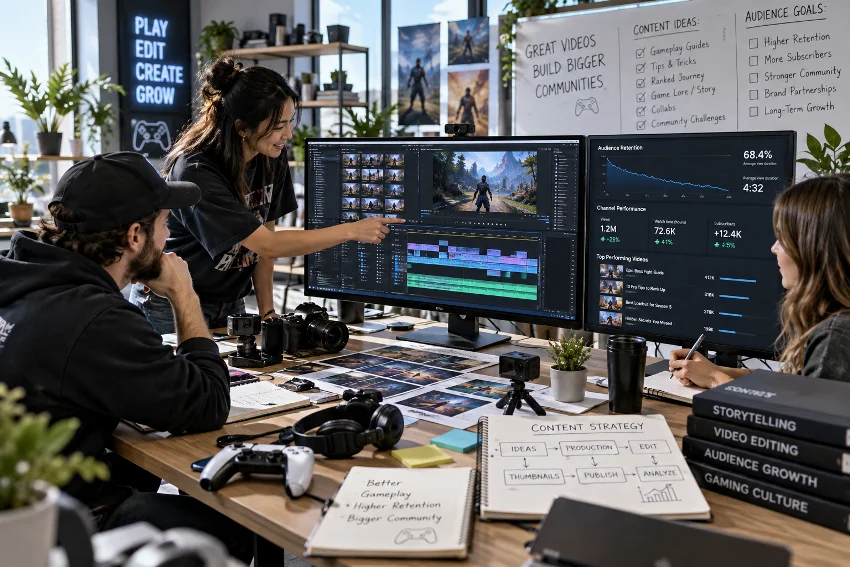
Excellent audio frequently makes a bigger difference to the viewing experience than minor improvements in video resolution.
Viewers may tolerate slightly imperfect graphics, but unclear commentary, clipping, or inconsistent volume can quickly become frustrating.
Audio quality deserves its own production strategy.
Separating Gameplay, Voice, and Communication Audio
Advanced creators benefit from recording different audio sources on separate tracks.
These may include microphone commentary, game sound, voice chat, and background music.
Independent tracks provide greater flexibility during editing.
For example, if teammates suddenly become louder during an intense match, their voices can be adjusted without affecting the creator’s commentary.
Separate tracks also make it easier to remove unwanted conversations or replace problematic music.
A structured audio workflow becomes particularly valuable when repurposing live streams into shorter edited videos.
Microphone Processing and Sound Consistency
Microphone placement affects recording quality as much as software processing.
Positioning a microphone appropriately and reducing unnecessary room noise can improve vocal clarity.
Common processing tools include noise suppression, equalisation, compression, and limiters.
Compression helps manage differences between quiet speech and louder reactions, while a limiter can reduce excessive peaks.
However, aggressive processing may make voices sound unnatural or introduce unwanted artifacts.
Creators should listen to test recordings through headphones and ordinary speakers before finalising their settings.
Maintaining an appropriate balance between commentary and game audio helps viewers follow both the gameplay and the creator’s explanation.
Designing an Immersive Sound Experience
Sound also contributes to storytelling.
Subtle effects can emphasise important events, while carefully selected music may improve pacing during transitions.
However, constant sound effects can make content exhausting.
A tactical gameplay analysis might benefit from reduced background music, allowing viewers to concentrate on footsteps, environmental cues, and verbal explanations.
An entertaining highlights compilation may use a more energetic soundtrack.
The important principle is intentional sound design rather than maximum volume.
4. Gameplay Storytelling and Advanced Editing Techniques
Raw gameplay contains many moments that are meaningful to the player but uninteresting to an outside audience.
Editing transforms those moments into a narrative viewers can follow.
Professional creators think about pacing, anticipation, context, and emotional payoff.
Creating Strong Hooks and Narrative Structure
The opening moments of a gaming video should give viewers a reason to continue watching.
Instead of starting with a long introduction, creators can present an interesting challenge, unexpected result, or compelling question.
Imagine a video exploring whether an unconventional weapon can succeed in high-ranked competitive matches.
The introduction could reveal a dramatic moment before returning to explain the strategy behind it.
This creates curiosity without revealing the complete outcome.
A useful narrative structure moves through setup, challenge, progression, turning point, and resolution.
Not every gaming video requires a dramatic storyline, but viewers should understand why the footage matters.
Editing for Retention and Engagement
Advanced editing focuses on removing unnecessary friction.
Long loading screens, repetitive travel sequences, and extended periods without meaningful action can weaken the viewing experience.
Strategic cuts help maintain momentum while preserving essential context.
However, excessive editing creates a different problem.
Constant zooms, transitions, loud sound effects, and rapid cuts may overwhelm audiences who are trying to understand complex gameplay.
The editing style should match the content’s purpose.
Educational videos often benefit from clear visual annotations, slow-motion replays, and tactical explanations.
Entertainment-focused content may use quicker pacing and stronger comedic timing.
Using Motion Graphics and Visual Explanations
Motion graphics can make complicated gameplay concepts easier to understand.
Directional arrows, positioning diagrams, highlighted interface elements, and simplified movement paths help audiences recognise important details.
For example, a strategy video about a multiplayer battle arena could pause gameplay to show positioning mistakes and alternative rotations.
Visual explanations become particularly useful when discussing decisions that happen too quickly during normal playback.
Creators should maintain consistent typography, colours, and graphic styles across videos.
A recognisable visual language improves clarity and strengthens channel identity.
5. Advanced Streaming Technology and Broadcast Engineering
Live streaming introduces challenges that prerecorded videos don’t face.
While recorded content can be corrected during editing, live broadcasts require technical stability and immediate problem-solving.
Creators must manage encoding, networking, audio, graphics, and audience interaction simultaneously.
Understanding Encoding and Streaming Protocols
Streaming software compresses video before transmitting it to a platform.
Common codecs include H.264, H.265, and AV1, although supported options vary across platforms and devices.
Encoder selection influences image quality, hardware utilisation, compatibility, and bandwidth requirements.
YouTube supports RTMPS streaming, which encrypts data during transmission.
Its live encoder guidance recommends a two-second keyframe interval and constant bitrate encoding for supported workflows.
However, creators shouldn’t assume that every streaming platform uses identical technical requirements.
Platform-specific recommendations should always be checked before configuring a broadcast.
Balancing Latency, Quality, and Stability
Streaming latency describes the delay between an event happening and viewers seeing it.
Lower latency can improve chat interaction, particularly during competitive gameplay, audience challenges, and interactive streams.
However, reducing latency may increase sensitivity to network instability.
A reliable connection with adequate upload capacity is essential.
Creators should test their actual upload performance while running games and other software normally used during broadcasts.
A theoretical internet speed advertised by a provider doesn’t guarantee consistent real-world streaming performance.
When instability occurs, reducing output resolution or bitrate may provide a better experience than repeatedly dropping frames at higher settings.
Designing Professional Streaming Scenes
A polished broadcast often uses several coordinated scenes.
These might include a gameplay-focused layout, starting screen, temporary break screen, and full-camera discussion layout.
Transitions should be visually consistent without becoming distracting.
Alerts, chat overlays, and audience notifications can encourage interaction, but too many elements may obscure important gameplay information.
A competitive shooter stream, for example, should avoid placing large graphics over critical interface areas.
The best broadcast layout balances channel branding with unobstructed gameplay.
6. Gaming Content SEO and Video Discoverability
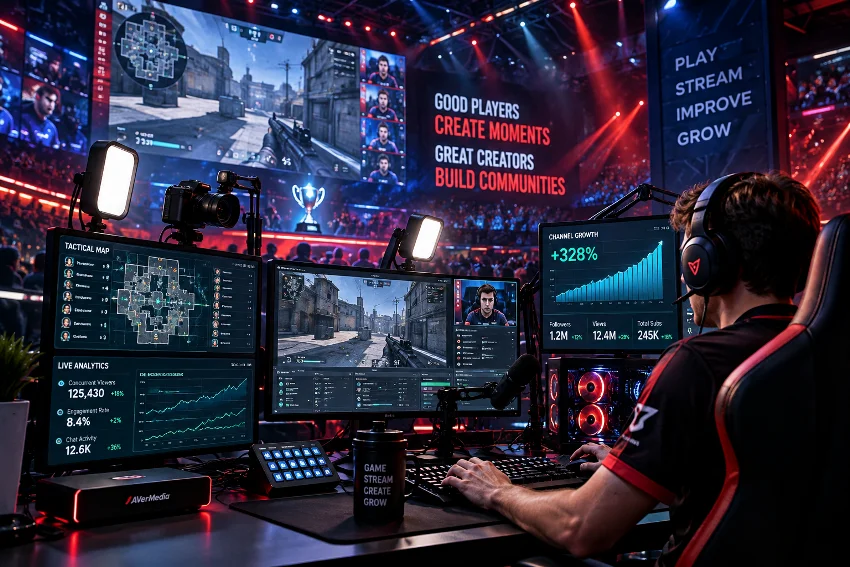
Even professionally produced videos need effective discoverability strategies.
Search engines and recommendation systems connect audiences with content using several signals, including relevance, viewer behaviour, and presentation.
Creators should therefore consider distribution while planning their videos, not just after editing is complete.
Developing Search-Focused Gaming Topics
Gaming search demand frequently emerges around updates, patches, strategies, equipment configurations, and difficult game mechanics.
Creators can identify useful topics by analysing recurring community questions and available search data.
For example, a video titled “Best Settings for Competitive Gameplay” is broad and potentially difficult to differentiate.
A more specific title such as “Advanced Recoil Control Settings for Ranked FPS Matches” communicates a clearer audience benefit.
Keyword research should identify actual user intent rather than encourage repetitive phrasing.
Titles, descriptions, chapters, and spoken explanations should accurately represent what viewers will receive.
Improving Thumbnails and Click-Through Rates
Thumbnails influence whether viewers choose to investigate a video.
Effective designs usually communicate one clear concept through readable imagery, strong contrast, and an obvious visual focal point.
A thumbnail promoting a difficult boss challenge might show the enemy, a dramatic gameplay moment, and a short phrase describing the challenge.
Avoid filling the image with too many unrelated elements.
YouTube Studio provides impressions and click-through-rate metrics that help creators evaluate audience response.
However, a higher click-through rate isn’t automatically evidence of stronger content.
Misleading thumbnails may attract initial clicks while disappointing viewers.
The best packaging accurately matches the actual video.
Creating Connected Content Pathways
Creators can improve the audience experience by organising related videos into logical sequences.
A beginner-to-advanced strategy series, for example, gives viewers a clear reason to explore additional content.
Playlists, relevant end screens, and contextual references can support this journey.
Short-form videos may introduce interesting mechanics, while longer tutorials provide detailed explanations.
Live streams can then demonstrate those techniques in real situations.
This creates a cohesive viewing experience rather than isolated content with no clear relationship.
7. Audience Analytics and Sustainable Channel Growth
Growth requires more than checking view counts after every upload.
Creators need to understand who watches, why they stay, and which content encourages them to return.
Analytics should support better decisions without completely controlling creative direction.
Measuring Audience Retention and Watch Time
Audience retention indicates how well a video maintains attention throughout its duration.
YouTube Analytics provides information about watch time, average view duration, and important moments within individual videos.
Suppose a ten-minute gaming tutorial experiences a sharp audience decline after the first minute.
This might indicate that the introduction is too long, the promised topic is delayed, or viewers received enough information to leave.
The data doesn’t automatically reveal the cause.
Creators should compare retention patterns with the video’s structure and viewer feedback before making changes.
Similarly, a longer average viewing duration doesn’t necessarily mean the content is more effective if the video serves a different audience need.
Evaluating Channel Performance Metrics
A practical growth dashboard might include the following metrics:
| Metric | Strategic Purpose |
|---|---|
| Impressions | Evaluate potential content reach |
| Click-Through Rate | Assess title and thumbnail appeal |
| Average View Duration | Understand viewing engagement |
| Audience Retention | Identify weak or strong segments |
| Returning Viewers | Evaluate audience loyalty |
| Subscriber Conversion | Assess channel growth effectiveness |
| Traffic Sources | Understand content discovery |
These metrics should be interpreted together.
A video with relatively modest reach but strong returning-viewer engagement may serve an important role in building a dedicated community.
Meanwhile, a viral video might attract substantial traffic without creating lasting audience relationships.
Sustainable growth depends on understanding both reach and audience quality.
Building Community Through Interaction
Gaming communities often develop around shared experiences rather than individual videos.
Livestream conversations, audience challenges, community discussions, and recurring events can strengthen relationships.
Twitch Creator Camp recommends understanding audience behaviour, reviewing analytics, and building connections through interactive experiences.
Creators should encourage genuine participation rather than relying on artificial engagement tactics.
For example, viewers might vote on an upcoming challenge or suggest strategies for a future gameplay experiment.
These interactions provide both community value and useful creative insights.
8. Monetisation, Automation, and Scalable Production Workflows
As gaming channels grow, production becomes more demanding.
Creators may need to manage recording, editing, publishing, sponsorship discussions, analytics, and community activity.
A scalable workflow helps maintain quality without requiring every task to be completed manually.
Designing an Efficient Production Pipeline
An organised workflow begins with research and topic selection.
Creators then prepare recording objectives, capture footage, organise files, complete editing, create promotional assets, and schedule publication.
Standardised project folders and naming conventions reduce confusion.
For instance, raw footage, commentary, graphics, music, and final exports should be clearly separated.
Templates can accelerate repetitive activities such as subtitles, transitions, audio processing, and thumbnail layouts.
However, automation should support creativity rather than make every video feel identical.
Using AI-Assisted Editing and Content Repurposing
AI-powered tools can assist with transcription, subtitle preparation, silence detection, footage searching, and preliminary clip selection.
These functions can save time when processing long gaming sessions.
However, automated systems may fail to recognise why a particular moment is entertaining or strategically important.
Human review remains essential for accurate explanations, effective pacing, and appropriate context.
A two-hour livestream could produce a detailed gameplay analysis, several short highlights, and a community recap.
Each format should be edited for its intended audience rather than simply uploaded as an unchanged excerpt.
Developing Responsible Monetisation Strategies
Professional gaming creators may generate revenue through platform advertising, subscriptions, sponsorships, affiliate relationships, merchandise, or digital products.
A diversified approach can reduce dependence on a single source.
However, commercial opportunities should remain consistent with audience expectations.
Promoting irrelevant products or hiding sponsorship relationships can weaken trust.
Creators also need to consider publisher policies, music licensing, and the rights associated with game footage.
YouTube explains that monetisation of gaming videos may depend on publisher permissions and whether the content provides sufficient original commentary or educational value.
Responsible growth combines commercial planning with transparent communication and original creative contributions.
9. Developing a Long-Term Gaming Content Growth Strategy
Successful content operations require ongoing experimentation rather than reliance on a single popular format.
Gaming trends change, audience preferences evolve, and new distribution opportunities emerge.
Creators need a strategy flexible enough to respond without losing their identity.
Building a 90-Day Content Development Roadmap
A practical three-month plan can begin with production improvements and audience research.
During the first month, the creator might focus on recording consistency, audio quality, thumbnail design, and identifying reliable content themes.
The second month could introduce more structured publishing, regular audience analysis, and experiments with different editing formats.
By the third month, the creator can evaluate which topics attract returning viewers and which formats require excessive production effort.
A hypothetical planning dashboard might look like this:
| Development Area | Initial Position | 90-Day Objective |
|---|---|---|
| Publishing Consistency | 1 video weekly | 2 videos weekly |
| Production Workflow | 12 hours per video | 9 hours per video |
| Average View Duration | 4 minutes | 5 minutes |
| Returning Viewers | Baseline established | Improve trend |
| Recording Reliability | Occasional frame drops | Stable test recordings |
These targets are illustrative planning objectives rather than guaranteed performance outcomes.
Creators should adjust goals based on available resources, content complexity, and audience behaviour.
Balancing Creativity With Business Performance
Not every creative experiment will attract immediate attention.
Some unusual formats require several attempts before audiences understand their value.
Creators should therefore distinguish between unsuccessful execution and genuinely weak concepts.
An underperforming strategy video might have valuable information but poor presentation.
Instead of abandoning the topic completely, the creator could experiment with clearer introductions, improved thumbnails, or more engaging demonstrations.
Regular performance reviews make it easier to identify these opportunities.
The strongest gaming brands remain recognisable while continuously refining how their content is produced and delivered.
Professional Gaming Video Production combines gameplay expertise, reliable recording technology, engaging storytelling, effective streaming, and intelligent audience analysis.
Long-term success comes from improving the complete workflow rather than chasing views through isolated tactics.
Start by upgrading your most important production weakness, measure the results, and build a repeatable content strategy that delivers lasting value to your gaming community.
Every topic offers more to discover beyond a single article. Explore additional knowledge through carefully selected reading opportunities and related references. By examining different explanations and supporting materials, readers can uncover useful information, strengthen their understanding, and develop fresh perspectives on the discussion.