

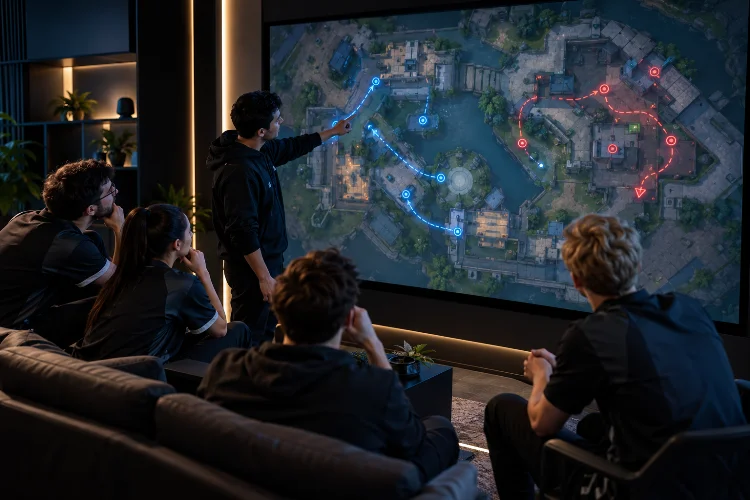
Ever watched a professional esports match and wondered how top teams seem to predict their opponents’ next moves? A perfectly timed rotation, unexpected flank, or coordinated team fight rarely happens by pure luck.
Behind those impressive decisions are countless hours of practice, strategic preparation, and detailed gameplay analysis.
One of the most effective ways to understand those decisions is by studying professional match replays.
Identifying tactical patterns through professional match replays allows players, coaches, and esports enthusiasts to uncover the strategies hidden beneath fast-paced competitive action.
Instead of focusing only on spectacular eliminations, replay analysis reveals how teams control space, manage resources, respond to pressure, and adapt to their opponents.
The exciting part? You don’t need to be a professional analyst to get started.
With the right observation methods, replay tools, and a little patience, anyone can begin recognizing meaningful tactical habits in games like Counter-Strike 2, VALORANT, League of Legends, and Dota 2.
This guide explores practical replay analysis techniques, common strategic patterns, useful performance indicators, and methods for turning professional gameplay observations into smarter competitive decisions.
1. Understanding Tactical Pattern Recognition in Esports
Professional esports matches contain enormous amounts of strategic information. Every movement, ability activation, rotation, and positioning decision contributes to the overall flow of the game.
However, these details are difficult to process while watching live action.
Replay analysis makes it possible to revisit important moments, examine different perspectives, and understand how individual decisions connect to larger team strategies.
What Are Tactical Patterns?
Tactical patterns are recurring behaviors or decision sequences that appear under similar competitive conditions.
For example, a Counter-Strike 2 team might repeatedly place three players near one bombsite before switching its defensive setup after receiving specific information.
In League of Legends, a team may regularly move its support player toward the river shortly before an important objective becomes available.
These behaviors become strategically meaningful when they repeat consistently and serve a recognizable purpose.
The important distinction is that a single impressive play doesn’t automatically represent a tactical pattern. Analysts need multiple examples before drawing reliable conclusions.
Micro Tactics Versus Macro Strategy
Competitive gameplay analysis generally involves two interconnected levels.
Micro tactics describe individual actions, including aiming decisions, movement mechanics, ability combinations, and positioning during fights.
Macro strategy focuses on broader decisions such as map control, resource allocation, objective timing, and team rotations.
Imagine a VALORANT player winning a difficult one-versus-two engagement.
The individual performance demonstrates mechanical skill, but the wider replay might reveal that the situation became possible because teammates previously forced the opponents to waste important abilities.
Understanding both levels provides a more complete explanation of why a particular play succeeded.
2. Choosing the Right Professional Match Replays
Not every replay provides the same analytical value.
A short highlight compilation might showcase impressive mechanical skills, but it often removes the preparation and decision-making that made those moments possible.
For tactical analysis, complete match recordings are generally more valuable.
Full Match VODs Versus Interactive Replays
A VOD, or video on demand, is a recorded broadcast or gameplay session.
Professional tournament VODs are useful because they often include observer perspectives, commentators, scoreboards, and information about the overall competitive situation.
Interactive replays offer additional flexibility.
VALORANT’s replay system, introduced in September 2025, supports switching between player perspectives, free-camera observation, playback-speed adjustments, and timeline navigation.
League of Legends also includes replay functionality that allows viewers to follow individual champions and revisit important events.
These features make it easier to investigate events that a live broadcast may have missed.
However, access varies by game and competition. A public tournament broadcast doesn’t necessarily mean its complete interactive replay is available.
Selecting Matches With Specific Learning Goals
Start with a clear analytical objective.
If you want to improve defensive positioning, prioritize matches featuring teams recognized for disciplined defensive setups.
If your focus is objective control, study matches with frequent contests around major map objectives.
Consider reviewing several matches involving the same team on the same map or under similar strategic conditions.
This makes comparisons more meaningful because fewer variables change between observations.
Also pay attention to game patches.
Major balance updates can change character abilities, map layouts, weapon effectiveness, and strategic priorities, making older tactical examples less directly applicable.
3. Building a Structured Replay Analysis Workflow
Watching professional gameplay repeatedly doesn’t automatically produce useful insights.
Without a clear method, it’s easy to spend hours admiring impressive plays while missing the decisions that created them.
A structured review process helps transform ordinary viewing into actionable tactical research.
First Viewing: Understand the Overall Match
Begin by watching a match at normal speed without constantly pausing.
Focus on the broader competitive narrative.
Observe which team controls important areas, how momentum changes, and when major strategic adjustments occur.
Instead of analyzing every movement immediately, identify moments worth investigating later.
For example, a team might lose several consecutive rounds before dramatically changing its defensive approach.
That transition deserves closer examination because it may reveal how the team responds to pressure.
Second Viewing: Examine Critical Decisions
During the second viewing, pause at meaningful decision points.
These might include an early rotation, unexpected engagement, objective setup, or major resource commitment.
Ask what information was available before the decision happened.
This matters because replay viewers often possess information that players didn’t have during the original match.
A rotation might appear obviously incorrect when the observer can see every opponent’s location.
However, from the player’s perspective, the same decision might have been reasonable.
Third Viewing: Compare Repeated Situations
After identifying an interesting sequence, search for similar situations in other rounds or matches.
Record the timestamp, game state, player positions, available resources, and eventual outcome.
Keep your notes short enough to review quickly.
Instead of writing that a team has poor defensive coordination, identify the specific behavior: two defenders repeatedly rotate away from a site after receiving only one piece of enemy information.
This creates an observable pattern that can be tested rather than a vague criticism.
4. Analyzing Map Control, Rotations, and Positioning
Map control is one of the most revealing elements of professional gameplay.
Strong teams don’t simply react to enemies appearing on their screens. They actively manage valuable areas, restrict opponent movement, and create favorable engagements.
Understanding these patterns requires looking beyond the immediate fight.
Tracking Rotations and Map Pressure
A rotation occurs when players move from one area to another in response to information, objectives, or strategic plans.
In tactical shooters, rotations often determine whether defenders arrive before attackers establish control.
In MOBAs, coordinated movement between lanes can create numerical advantages around objectives.
Consider a hypothetical League of Legends team preparing for a dragon fight.
Its mid laner pushes the wave, the support moves toward the river, and the jungler clears nearby vision before the objective becomes available.
Each action contributes to the team’s eventual position.
When studying the replay, identify which movement happened first and whether the sequence repeats in later objective setups.
Recognizing Defensive Structures
Defensive positioning often reveals a team’s preferred response to different threats.
Some teams concentrate players around important entry points, while others distribute defenders to maintain information across multiple areas.
Pay attention to crossfires, escape routes, sightlines, and backup positions.
In Counter-Strike 2, a defender may deliberately avoid an early confrontation because another teammate is positioned to trade an elimination.
That positioning might look passive when viewed individually.
From a wider perspective, it becomes part of a coordinated defensive structure.
Identifying Map Control Trade-Offs
Controlling one area often means leaving another area vulnerable.
Professional teams constantly make these trade-offs.
A team that commits several players toward an objective may gain local numerical superiority but surrender pressure elsewhere.
Replay analysis helps reveal whether that sacrifice was deliberate and whether it created sufficient value.
The most useful question isn’t simply where players moved, but what they gained or gave up by moving there.
5. Identifying Timing Patterns and Resource Management
Timing is one of the most powerful sources of competitive advantage.
A perfectly executed strategy can fail if it begins too early or too late. Meanwhile, a relatively simple maneuver can succeed when opponents lack the resources needed to respond.
Professional replays offer a practical way to study these relationships.
Detecting Timing Windows
Timing windows are short periods when a particular action becomes more favorable.
For example, a VALORANT team might initiate a site attack immediately after defenders use important utility elsewhere.
In Dota 2, players may attempt a major objective after eliminating an opponent or gaining a significant item advantage.
These situations share a common principle: teams exploit temporary differences in strength, information, or availability.
When reviewing a sequence, record what changed immediately before the engagement.
Was an important ability unavailable? Had a defender moved away? Did an opponent reveal their position?
These details often explain why a team chose that particular moment.
Monitoring Ability and Economy Cycles
Resource management patterns are especially important in competitive games with cooldowns, equipment purchases, or limited consumables.
In tactical shooters, economic decisions can influence how aggressively a team approaches the next round.
In MOBAs, ultimate abilities, summoner spells, vision tools, and major item completions shape engagement opportunities.
A useful method is to compare resource availability immediately before successful and unsuccessful engagements.
If a team repeatedly wins fights when its primary initiation abilities are available, that relationship deserves investigation.
However, correlation alone doesn’t prove those abilities caused the victories.
Player positioning, opponent mistakes, and numerical advantages may also contribute.
Understanding Tempo Changes
Tempo describes the pace at which a team creates pressure and forces decisions.
Some teams prefer gradual map control before committing to objectives. Others generate constant pressure through rapid rotations and early engagements.
Professional teams also change tempo deliberately.
A sudden slowdown may encourage opponents to overextend, while rapid aggression can prevent a defending team from completing its setup.
Watch for these shifts and identify the conditions that trigger them.
They often reveal more about a team’s strategic identity than its average number of eliminations.
6. Discovering Opponent Tendencies and Strategic Adaptations
One of the greatest advantages of replay analysis is its ability to reveal repeated opponent habits.
Professional teams prepare for specific opponents by studying preferred strategies, recurring setups, and common responses to pressure.
This process is often called opponent scouting.
Recognizing Repeated Opening Strategies
Many teams rely on familiar opening structures.
A tactical shooter team might establish early mid-map control before choosing which bombsite to attack.
A MOBA team may repeatedly direct early jungle pressure toward a particular lane.
These openings can become predictable when opponents recognize the circumstances that trigger them.
To identify genuine tendencies, compare several rounds or matches instead of relying on a single example.
Look for repeated opening positions, movement sequences, and resource commitments.
Studying Reactions to Pressure
A team’s response to losing control can reveal its defensive habits.
Some teams immediately rotate additional players toward threatened areas. Others maintain their original structure and attempt to recover territory later.
Neither response is automatically superior.
Its effectiveness depends on available information, remaining resources, and the opponent’s positioning.
For example, imagine a team that repeatedly abandons one side of the map after a teammate is eliminated elsewhere.
An opponent might exploit this tendency by applying early pressure before attacking the weakened area.
However, analysts should confirm that the response occurs under comparable conditions before treating it as predictable behavior.
Identifying Mid-Match Adaptations
Professional competition rarely follows a fixed script.
Strong teams recognize when their initial approach stops working and adjust their strategies.
Look for changes in character positioning, engagement timing, economy decisions, or objective priorities after unsuccessful rounds.
A team might initially rely on aggressive openings before switching to slower information-gathering setups.
Understanding why the adaptation happened is just as important as recognizing the change itself.
Occassionally, a seemingly minor adjustment can completely alter how opponents approach the next engagement.
7. Using Data and Replay Analytics to Validate Tactical Patterns
Visual observation is essential, but it can also be misleading.
Viewers naturally remember spectacular plays more easily than ordinary decisions. This creates a risk of exaggerating how frequently a particular strategy succeeds.
Basic quantitative analysis helps reduce that bias.
Measuring Pattern Frequency
Start by counting how often a specific behavior occurs.
Suppose a hypothetical team uses an aggressive mid-map opening in 12 comparable rounds and wins 8 of them.
That produces a win rate of approximately 66.7% for the observed sample.
However, the result doesn’t establish that the opening is consistently effective.
Twelve rounds represent a limited dataset, and outcomes may depend on opponent strength, economy, map side, or other factors.
The better approach is to expand the sample and record relevant conditions alongside the results.
Connecting Data With Match Context
Useful performance indicators vary by genre.
For tactical shooters, analysts might track opening engagements, trade opportunities, site-entry timing, utility usage, and defensive rotations.
For MOBAs, relevant indicators include objective control, vision coverage, gold differences, kill participation, and movement around major objectives.
Riot’s Developer Portal provides match-data APIs for supported games, helping developers build statistical analysis workflows.
However, match statistics alone don’t capture every tactical detail.
A high objective-control rate doesn’t necessarily explain how a team consistently creates the conditions needed to secure those objectives.
That explanation usually requires combining numbers with replay observations.
Avoiding False Tactical Conclusions
One of the biggest mistakes in esports analysis is confusing repeated outcomes with repeated causes.
A team may win several fights using similar positioning, but those victories might involve significantly different opponent mistakes.
Separate the behavior being studied from the result being measured.
Consider whether the same strategy failed under other conditions.
Also compare succesful examples with unsuccessful attempts rather than collecting only evidence supporting your initial theory.
A reliable tactical conclusion should explain not only when a strategy works, but when its effectiveness begins to decline.
8. Turning Replay Insights Into Practical Competitive Improvement
The ultimate purpose of tactical analysis isn’t collecting interesting observations.
It’s using those observations to improve decision-making, teamwork, and strategic preparation.
Even the most detailed replay report has limited value if nobody applies its findings.
Translating Professional Strategies Into Your Own Games
Start with one clear tactical lesson.
If professional teams consistently establish map control before contesting objectives, experiment with a similar approach during your own matches.
However, avoid copying their movements without considering context.
Professional strategies depend on communication, mechanical ability, team composition, and coordinated timing.
A five-player strategy requiring precise communication may be difficult to reproduce in an uncoordinated ranked environment.
Instead, identify the underlying principle and adapt it to your circumstances.
For example, the transferable lesson might be to establish vision before committing to an objective rather than copying every professional player’s exact position.
Creating Focused Practice Sessions
Turn each observation into a specific practice objective.
Instead of telling teammates to improve rotations, define a recognizable trigger and expected response.
For instance, a team might practice responding to enemy pressure while maintaining at least one reliable information source on the opposite side of the map.
After several practice matches, review whether the behavior improved.
Keep mechanical practice and tactical practice seperate when possible.
Mechanical training develops execution, while strategic review focuses on choosing the right actions under the right conditions.
Both contribute to competitive performance, but they benefit from different feedback methods.
Building a Tactical Pattern Library
A pattern library is a simple collection of categorized replay observations.
It can include opening strategies, defensive formations, objective setups, resource combinations, and common opponent responses.
For each entry, record the situation, timestamp, observed behavior, likely purpose, and potential counterplay.
Add a confidence label based on the available evidence.
A behavior observed once might be classified as a possible idea, while one repeated across several comparable matches could receive stronger confidence.
This makes your analysis easier to retrieve before practice or competition.
Reviewing Results and Refining Strategies
After applying a new tactic, return to your own match recordings.
Compare the original plan with what actually happened.
Did players rotate at the intended time? Were resources available? Did the team recieve the information needed to execute the strategy?
These questions help distinguish poor execution from an ineffective plan.
Over time, repeated observation, practice, and evaluation create a feedback loop.
The goal isn’t to imitate professionals perfectly. It’s to develop a better understanding of competitive decision-making and use that knowledge consistently.
Mastering identifying tactical patterns through professional match replays can completely change how you understand competitive esports.
Instead of watching matches only for impressive eliminations or dramatic victories, you’ll begin recognizing the positioning decisions, timing windows, resource management, and team coordination that influence the outcome.
Effective replay analysis requires structured observation, multiple comparable examples, and a willingness to question initial assumptions. Combining visual evidence with basic performance statistics makes tactical conclusions more reliable and easier to apply.
Most importantly, studying professional gameplay should lead to practical improvements rather than endless note-taking.
Ready to sharpen your competitive instincts? Choose a professional match, identify one recurring tactical behavior, and investigate how it influences the game. Then test that lesson in your own matches and review the results.
Every replay offers another opportunity to understand the game more deeply.