

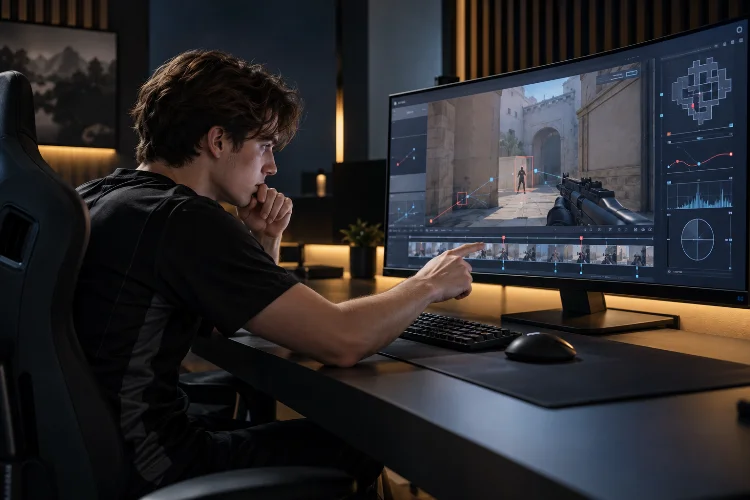
Ever lost a competitive match and wondered exactly what went wrong? Maybe you missed a crucial headshot, reacted too slowly to an opponent’s movement, or made a positioning mistake that cost your team the final round.
During live gameplay, everything happens incredibly fast. You might feel like you made the correct decision, only to discover later that a small mistake changed the outcome.
That’s where frame-by-frame gameplay analysis for advanced competitive players becomes incredibly valuable.
Instead of relying on memory or frustration, this technique allows you to examine individual moments, identify mechanical weaknesses, and understand the decisions behind successful or unsuccessful plays.
Professional esports teams regularly use replay reviews, match analysis, and performance feedback to improve competitive consistency. Fortunately, individual players can apply many of the same principles without expensive coaching software.
Whether you’re competing in VALORANT, Counter-Strike 2, League of Legends, Street Fighter, or another high-level competitive game, detailed gameplay review can reveal patterns that normal practice misses.
In this guide, we’ll explore how to analyze gameplay recordings, measure important timing differences, recognize tactical mistakes, and transform replay observations into meaningful improvements.
1. Understanding Frame-by-Frame Gameplay Analysis
Frame-by-frame gameplay analysis involves examining recorded gameplay in small visual increments to understand exactly how events unfold.
Rather than watching an entire match at normal speed, players pause, rewind, and inspect specific moments where timing, positioning, or decision-making influenced the result.
Why Individual Frames Matter
Competitive gaming often comes down to tiny windows of opportunity.
In a tactical shooter, moving your crosshair toward an opponent slightly too late could mean losing a duel. In a fighting game, misunderstanding attack recovery might result in an avoidable punish.
At 60 frames per second, each recorded video frame represents approximately 16.67 milliseconds. At 120 FPS, the interval drops to roughly 8.33 milliseconds.
These differences explain why slow-motion footage can reveal details that are nearly impossible to recognize during intense gameplay.
However, recorded video frames aren’t necessarily the same as a game’s internal simulation frames or server ticks. A 60 FPS recording cannot capture every visual update from gameplay running at 240 FPS.
Understanding that distinction prevents inaccurate conclusions about mechanical timing.
Looking Beyond Obvious Mistakes
Many players only review moments when they die or lose a fight.
While those situations are useful, they don’t always reveal the actual source of the problem.
For example, a failed duel might appear to be an aiming mistake. Closer inspection could reveal poor crosshair placement, unnecessary movement, or a disadvantageous engagement angle.
The objective is to identify the earliest meaningful mistake, not simply the final action that produced the loss.
2. Setting Up a Reliable Gameplay Recording System
High-quality analysis starts with footage that accurately represents the player’s experience.
Blurry recordings, inconsistent frame rates, or missing audio can make important details difficult to interpret.
Choosing the Right Recording Tools
OBS Studio is a practical option for capturing gameplay, audio, and communication.
It supports different recording formats, encoder settings, and frame rates, making it suitable for both casual reviews and more detailed competitive analysis.
For most players, recording at 1080p and 60 FPS provides a useful starting point. Higher recording rates may offer more temporal detail when supported by the hardware and editing workflow.
The priority should be stable capture performance rather than unnecessarily demanding settings.
A recording that introduces serious performance drops during matches can interfere with the gameplay you’re trying to improve.
Using Built-In Replay Systems
Some games include dedicated replay systems that provide more information than a standard screen recording.
VALORANT’s replay system, for example, supports different player perspectives, free-camera viewing, playback-speed adjustments, and navigation through important match events.
Overwatch has also offered replay tools that allow players to examine engagements from different viewing angles.
These features are valuable because your original perspective doesn’t show every event happening elsewhere on the map.
A replay might reveal that an enemy rotated earlier than expected or that a teammate was already positioned to support an engagement.
Where possible, use both native replay functionality and personal recordings. The two sources provide different types of evidence.
Organizing Your Recordings
Create seperate folders for ranked matches, scrims, tournament games, and mechanical practice.
Use filenames containing the date, map, character or role, and match result. Add timestamps for moments you want to revisit.
Good organization makes it easier to compare similar situations without repeatedly searching through hours of footage.
3. Breaking Down Critical Gameplay Moments
Once your recordings are ready, the next challenge is knowing what to examine.
Watching every second in extreme slow motion is rarely efficient. Instead, identify meaningful events and build a short timeline around them.
Identify the Decision Window
Start several seconds before an important mistake.
In a tactical shooter, examine what happened before the opponent appeared. Consider your crosshair placement, movement direction, available cover, and information recieved from teammates.
Then inspect the moment of contact.
Did you stop moving before firing? Was the crosshair already aligned with the expected angle? Did your opponent become visible before you reacted?
Finally, review the aftermath to understand how the exchange affected the wider round.
Measuring Frame Intervals
Suppose you’re reviewing a duel using a 60 FPS video recording.
Your analysis identifies the following hypothetical sequence:
| Event | Recorded Frame |
|---|---|
| Opponent first appears | 120 |
| Crosshair movement begins | 130 |
| First shot is fired | 138 |
| Elimination occurs | 145 |
The interval between the opponent appearing and your first shot is 18 recorded frames.
At 60 FPS, that equals approximately 300 milliseconds of recorded elapsed time.
However, this should not automatically be described as your biological reaction time.
Crosshair placement, anticipation, rendering delays, input latency, network conditions, and recording limitations can all affect the observed interval.
Treat measurements as useful comparisons across similar situations rather than perfect laboratory data.
Build a Repeatable Annotation System
Instead of writing lengthy descriptions for every event, create a small set of consistent labels.
Examples include late reaction, poor angle selection, wasted utility, incorrect target priority, and unnecessary exposure.
Each label should describe an observable behavior rather than a vague judgment.
Writing “I played badly” doesn’t help much. Recording “I exposed myself to two angles without teammate coverage” creates a clear improvement opportunity.
4. Analyzing Mechanical Execution and Timing
Mechanical skill is one of the easiest areas to examine through detailed gameplay footage.
However, effective mechanical analysis requires more than counting successful hits.
Crosshair Placement and Aiming Efficiency
In first-person shooters, good crosshair placement reduces the amount of correction required when an enemy appears.
Review the frames immediately before each duel.
Was your crosshair aligned with the most likely enemy position? Did you follow the expected movement path, or were you aiming at empty space?
Players sometimes blame slow reactions when their real problem is poor preparation.
A small adjustment in default crosshair positioning may improve duel consistency more effectively than simply practicing faster mouse movements.
Movement and Animation Timing
Movement affects accuracy, visibility, and vulnerability in different competitive titles.
In tactical shooters, players may need to coordinate stopping movement with firing. In platform fighters, movement options can influence spacing, recovery, and punish opportunities.
Review the transition between movement and action.
Look for situations where a player begins an attack before reaching a stable position or commits to an animation that leaves them vulnerable.
Understanding Fighting Game Frame Data
Fighting games provide particularly clear examples of frame-based decision-making.
Attacks commonly include startup, active, and recovery frames.
Startup represents the period before an attack becomes active. Active frames are when the attack can connect, while recovery describes the time before the character regains control.
Imagine a move that leaves its user at a six-frame disadvantage after being blocked.
If the opponent has an appropriately ranged attack that becomes active within that punish window, they may be able to respond before the original attacker recovers.
Actual outcomes also depend on distance, game-specific frame conventions, and other mechanics.
Learning to recognize these interactions turns frame data from confusing numbers into practical competitive knowledge.
5. Evaluating Positioning and Tactical Decision-Making
Mechanical execution matters, but advanced players must also understand why particular engagements occur.
A perfectly aimed shot cannot always overcome a strategically terrible position.
Map Control and Engagement Angles
Map positioning determines which information and opportunities are available to players.
When analyzing a lost engagement, examine how many angles were exposed and whether nearby cover offered a safer alternative.
Consider a Counter-Strike 2 player defending a bombsite.
The player might hold a narrow doorway but ignore a secondary approach. When two opponents attack from different directions, the defender becomes vulnerable despite having strong individual aim.
Reviewing the earlier positioning decision reveals the actual tactical weakness.
Decision Quality Versus Match Outcome
A successful play isn’t necessarily a good decision.
Imagine winning an aggressive one-versus-three engagement after taking an unnecessary risk.
The result looks impressive, but repeating the same approach against stronger opponents might consistently fail.
Likewise, a well-executed defensive rotation can still end in defeat because of factors outside the player’s control.
Judge decisions based on available information, reasonable alternatives, and expected consequences.
This prevents outcome bias from distorting your analysis.
Information Awareness
Advanced competitive gameplay depends on how players interpret incomplete information.
During a replay, identify what you genuinely knew at the time of each decision.
Did you have audio clues, minimap information, a teammate’s callout, or an opponent’s previously revealed position?
Avoid evaluating past decisions using information that only became visible afterward.
This distinction is especially important when using replay systems that reveal enemy positions through observer tools.
6. Improving Team Coordination Through Replay Analysis
Individual performance is only one part of competitive success.
Team-based games require players to coordinate movement, abilities, information, and timing.
Synchronizing Actions
Imagine two teammates preparing to enter a contested area.
One player begins the engagement while the other arrives half a second later. That delay may be enough for opponents to isolate the first player.
Slow-motion review can show whether both teammates had reasonable opportunities to act together.
Instead of assuming someone reacted poorly, examine positioning, communication timing, and the availability of supporting abilities.
In a coordinated team, identifying these details can improve future executions.
Reviewing Communication Quality
Communication should deliver useful information at the moment teammates need it.
Analyze whether important callouts were accurate, timely, and understandable.
For example, a teammate might correctly identify an opponent’s location but communicate the information after the relevant engagement has already started.
A useful review distinguishes delayed information from incorrect information.
Research into esports team communication has also explored relationships between communication patterns, emotional states, and competitive performance.
While individual studies shouldn’t be treated as universal rules, they reinforce the value of examining coordination alongside mechanical play.
Understanding Resource Management
In games featuring cooldowns, ultimates, equipment, or other limited resources, review when those resources were committed.
Did your team spend several powerful abilities to win an engagement that was already favorable?
Could one ability have been preserved for the next objective?
These questions help connect individual actions with longer-term match strategy.
7. Turning Gameplay Reviews Into Focused Training
Finding mistakes isn’t the same as fixing them.
The most important stage of video analysis involves translating observations into specific training activities.
Identify Recurring Problems
One isolated mistake doesn’t necessarily represent a serious weakness.
Instead, review several matches and search for repeated patterns.
Perhaps you consistently enter fights without checking secondary angles. Maybe you struggle against opponents using delayed attacks or frequently waste defensive abilities.
Track how often each issue appears in comparable situations.
This approach helps seperate persistent weaknesses from random events.
Design Targeted Practice Drills
Each recurring mistake should lead to a practical training objective.
If your main problem is crosshair placement, practice moving through common map routes while maintaining head-level alignment.
If you struggle with fighting game punish timing, use training-mode recordings to rehearse responses against specific unsafe moves.
For MOBA players, a recurring issue with late rotations might lead to drills focused on minimap checks, wave states, and objective timing.
Keep exercises narrow enough that you can measure progress.
Trying to improve every skill simultaneously often makes it difficult to recognize which adjustments are working.
Compare Before and After Performance
Choose a simple performance indicator related to your training objective.
For instance, count avoidable exposure mistakes per reviewed round or the percentage of punish opportunities successfully converted during practice.
Compare results across several sessions under reasonably similar conditions.
Don’t expect perfectly linear improvement.
Performance varies with opponent quality, fatigue, match context, and sample size. Look for consistant trends rather than judging progress from one exceptional game.
8. Building an Advanced Replay Review Routine
A repeatable review process is more valuable than occasionally analyzing one dramatic defeat.
You don’t need to spend hours studying every match.
A Practical 30-Minute Review Session
Spend the first five minutes identifying three significant moments from a recent game.
Use the next ten minutes to inspect those events at reduced speed, switching perspectives when available.
For another ten minutes, identify the likely root cause of each mistake and compare possible alternatives.
Use the final five minutes to select one specific training objective for your next session.
This is a suggested workflow rather than a scientifically established optimal schedule. Adjust it based on the game, your experience, and the complexity of the reviewed situations.
Compare Your Decisions With Stronger Players
Studying professional players can reveal efficient movement patterns, spacing choices, and strategic habits.
However, copying their actions without context can create new problems.
A professional may take an aggressive position because their teammates are covering specific routes or because they possess information unavailable to you.
When comparing footage, analyze the surrounding circumstances rather than simply imitating the final action.
Ask what information made the professional’s decision reasonable.
Avoid Common Analysis Mistakes
One major mistake is overanalyzing tiny timing differences that the recording cannot reliably measure.
Another is focusing exclusively on missed shots while ignoring positioning, preparation, and decision quality.
Players also sometimes become overly critical when reviewing unsuccessful matches.
A better approach is to maintain a balanced record of effective and ineffective decisions.
Recognizing successful habits is just as useful as identifying weaknesses because it shows which behaviors deserve reinforcement.
Finally, remember that recorded replays may not perfectly reproduce everything experienced during the live match.
Differences in latency, synchronization, replay reconstruction, and visibility can affect what appears on screen.
Use frame-by-frame inspection to support conclusions, not to invent certainty where the evidence is incomplete.
Frame-by-frame gameplay analysis offers competitive players a powerful way to understand the details behind their performance.
By reviewing critical moments, examining mechanical timing, evaluating positioning, and studying tactical decisions, players can identify weaknesses that remain hidden during live matches.
The real advantage comes from connecting those observations with focused training, consistent feedback, and measurable improvement.
Remember that a recording doesn’t tell the complete story. Context, network conditions, available information, and team coordination all influence what happens during a match.
The goal isn’t to eliminate every mistake immediately. It’s to develop a more accurate understanding of your gameplay and make better decisions over time.
Ready to improve your competitive performance? Record your next match, choose three critical moments, analyze them carefully, and turn your findings into one practical training goal. Small improvements can create meaningful long-term advantages.