

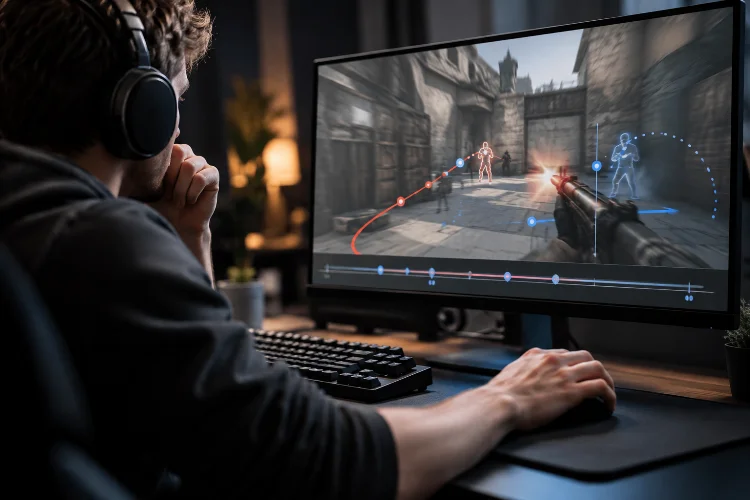
Ever watched a replay of your competitive gameplay and realized something felt completely different from what you remembered?
Maybe your aim looked slower, your movement seemed awkward, or you noticed a missed opportunity that was practically invisible during the actual match.
That’s a pretty common experience, even among highly skilled players.
At advanced competitive levels, improvement often becomes harder because obvious mistakes have already been eliminated.
Instead of major positioning errors or completely missed abilities, players struggle with subtle mechanical inconsistencies that appear only under pressure.
This is where using gameplay footage to diagnose high-level mechanical errors becomes a valuable training strategy.
Recorded gameplay allows players to examine small execution details, compare successful and unsuccessful actions, and identify recurring weaknesses that traditional practice might overlook.
From crosshair placement in tactical shooters to movement precision in fighting games, video analysis provides a clearer picture of how mechanical decisions translate into actual performance.
More importantly, it helps separate execution problems from tactical mistakes, network delays, and misleading assumptions.
In this guide, we’ll explore practical methods for reviewing footage, identifying hidden mechanical weaknesses, and turning those observations into targeted training routines that support long-term competitive improvement.
1. Why Gameplay Footage Reveals Mechanical Problems
Competitive games demand rapid decision-making, precise coordination, and constant attention to changing information.
During intense matches, players rarely have enough mental bandwidth to evaluate every movement or input they perform.
The Difference Between Perception and Execution
What you believe happened during a match isn’t always what actually occurred.
Imagine losing a duel in VALORANT. You might remember placing your crosshair directly on an opponent’s head, but your recording reveals that the crosshair briefly passed above the target before you fired.
That tiny correction error could explain the missed opportunity.
Gameplay recordings create an external record that players can review without the immediate pressure of competition.
They don’t eliminate interpretation errors, but they provide more evidence than memory alone.
Why Advanced Players Need More Detailed Feedback
Beginners often improve by fixing obvious problems such as unfamiliar controls, poor awareness, or inconsistent sensitivity settings.
Experienced competitors usually face more complicated challenges.
Their mechanics may look excellent during warm-ups but become unreliable during difficult engagements.
These inconsistencies can involve movement synchronization, premature inputs, inefficient aiming paths, or unnecessary animation commitments.
A 2024 study published in Behavioral Interventions examined video feedback for three Street Fighter V players. Researchers reported improvements in a targeted anti-air skill, with performance gains also observed in ranked matches.
Although the sample was small, the findings illustrate how specific video feedback can support mechanical skill development.
2. Recording Gameplay for Accurate Mechanical Analysis
Before identifying mistakes, you need footage that captures gameplay clearly and reliably.
Poor recording quality can hide important details or even create misleading evidence.
Choosing Recording Settings
OBS Studio is one of the most accessible tools for competitive gameplay recording.
For many players, 1080p resolution at 60 FPS provides a reasonable balance between visual clarity and system performance.
Players with sufficient hardware may benefit from recording at 120 FPS when analyzing extremely brief visual events.
At 60 FPS, one video frame represents approximately 16.67 milliseconds. At 120 FPS, that interval decreases to about 8.33 milliseconds.
However, a higher recording frame rate doesn’t automatically provide more accurate information if the source game or capture system cannot consistently deliver those frames.
Stable performance matters more than impressive recording specifications.
Avoiding Capture-Related Performance Problems
Recording software consumes system resources.
If your encoder becomes overloaded or your GPU lacks sufficient processing capacity, the captured video may contain skipped or repeated frames.
According to OBS documentation, reducing output demands and managing GPU usage can help resolve encoding performance problems.
Test your setup before recording important matches.
If possible, preserve game audio because footsteps, attack sounds, and ability cues can help establish the sequence of events.
Using Native Replay Systems
Built-in replay tools offer another useful perspective.
VALORANT’s replay system supports multiple player viewpoints, adjustable playback speeds, free-camera observation, and navigation between match events.
These features help players examine situations from angles unavailable during live gameplay.
However, engine-generated replays may reconstruct events differently from personal screen recordings.
For mechanical timing analysis, your original player-perspective recording is often especially valuable because it preserves what was displayed on your system.
Using both recording types can provide a more complete understanding of an engagement.
3. Identifying Different Types of High-Level Mechanical Errors
Not every failed action is caused by poor mechanics.
Advanced analysis begins by identifying what kind of failure actually occurred.
Execution Errors Versus Decision Errors
Mechanical errors happen when players fail to execute an intended action correctly.
Aiming slightly past a target, mistiming a defensive move, or pressing an ability too early are common examples.
Decision errors involve choosing an inappropriate action despite having the ability to perform it correctly.
Consider a player who successfully performs a difficult movement technique but enters an unfavorable engagement.
The movement execution may be flawless, while the tactical decision remains questionable.
Separating these categories prevents players from practicing the wrong skill.
Recognizing Timing and Coordination Problems
Many advanced mechanical weaknesses involve coordination between different actions.
For example, a player may begin firing before completing a movement adjustment.
Another player might attempt to cancel an animation before the game’s mechanics permit it.
These mistakes can be difficult to notice at full speed.
Slow-motion review makes it easier to examine how one action transitions into another.
Identifying Root Causes
A useful diagnostic method is to examine the sequence leading up to a mistake.
Start with the information available to the player, then examine the intended action, visible execution, and resulting outcome.
Suppose a missed shot appears to involve poor aim.
Closer inspection might reveal that the crosshair was initially positioned incorrectly, forcing a large correction under pressure.
The visible error is the missed shot, but the underlying weakness may be crosshair preparation.
4. Diagnosing Aiming Errors in Competitive Shooters
Aiming is one of the most frequently analyzed mechanical skills in esports.
However, simply counting missed shots provides limited information about why they occurred.
Crosshair Placement and Initial Alignment
Strong crosshair placement reduces the distance required to acquire a target.
During replay analysis, pause immediately before an opponent becomes visible.
Examine whether your crosshair aligns with the expected angle and approximate target height.
If you constantly need large corrections, the problem may involve positioning habits rather than raw aiming ability.
For example, a Counter-Strike 2 player repeatedly holding the crosshair too close to a corner may struggle against wide swings.
Adjusting the starting position could improve the engagement without requiring faster flicks.
Overflicking and Undershooting
Overflicking occurs when the crosshair moves beyond the intended target.
Undershooting happens when the movement stops short.
Both can result from several factors, including movement speed, sensitivity adaptation, inconsistent technique, or poor target prediction.
Replay analysis helps reveal whether one pattern occurs more frequently.
A player who repeatedly overshoots during rapid directional changes might benefit from controlled target-switching drills.
The objective should be improving accuracy and consistency, not automatically changing mouse sensitivity after a few missed shots.
Tracking and Target Switching
Tracking requires continuous adjustment as a target moves.
Review whether your crosshair follows the opponent smoothly or repeatedly falls behind.
In games with fast movement, delayed directional adjustments can create repeated aiming corrections.
Target switching introduces another challenge.
Players must disengage from one target and establish accurate alignment with another.
Examine whether unnecessary mouse movement increases the time required to complete that transition.
5. Detecting Movement and Positioning Execution Errors
Movement mechanics significantly influence competitive performance.
Even when players understand the correct positioning, small execution mistakes can reduce the effectiveness of their movements.
Movement-to-Attack Coordination
In tactical shooters, movement and weapon accuracy often interact.
Depending on the weapon and game mechanics, firing during movement may create accuracy penalties.
Review the transition between movement and shooting.
Did you fire before reaching the intended movement state? Did you continue holding a direction longer than necessary?
These questions help identify coordination problems rather than assuming every inaccurate shot results from weak aim.
Excessive Exposure During Movement
Movement analysis also reveals unnecessary exposure.
Imagine a player attempting to peek around a corner.
The intended action is a brief information-gathering movement, but the recording shows the character moving too far into the open.
This creates a mechanical spacing issue that may also have tactical consequences.
Review the beginning and ending positions of repeated peeks to identify inconsistencies.
Movement Mechanics Across Different Genres
Movement errors aren’t exclusive to shooters.
In fighting games, inconsistent spacing can cause attacks to miss or defensive movement to fail.
In platform fighters, poorly timed aerial movement may create vulnerable landing situations.
Even MOBA players can benefit from reviewing movement precision.
Unnecessary pathing adjustments, inaccurate cursor placement, and poorly timed movement commands can interfere with kiting or ability execution.
The exact mechanics vary, but the diagnostic principle remains the same: compare the intended movement with the observed result.
6. Using Frame-Level Analysis to Investigate Timing Errors
Some mechanical problems happen too quickly to evaluate through ordinary playback.
Frame-level analysis can reveal important timing relationships, although it requires careful interpretation.
Measuring Visible Action Intervals
Imagine reviewing a recorded shooter engagement at 60 FPS.
You identify the following hypothetical sequence:
| Event | Video Frame |
|---|---|
| Opponent becomes visible | 200 |
| Crosshair adjustment begins | 207 |
| First shot appears | 215 |
| Opponent is eliminated | 222 |
The interval between initial visibility and the first shot is 15 recorded frames.
At 60 FPS, this represents approximately 250 milliseconds of recorded time.
However, the figure shouldn’t automatically be interpreted as pure human reaction time.
The interval can include recognition, decision-making, aiming movement, input processing, rendering, and other delays.
It is most useful when comparing similar engagements recorded under similar conditions.
Understanding Fighting Game Frame Data
Fighting games provide another excellent example of detailed timing analysis.
Attacks typically include startup, active, and recovery phases.
Startup describes the period before an attack can connect, while active frames represent the window when the attack can hit.
Recovery is the remaining period before the character regains control.
Capcom’s Street Fighter educational material explains how these phases influence attack interactions and frame advantage.
For instance, an attack that is punishable after being blocked creates an opportunity for a suitable counterattack.
If the defending player repeatedly misses that opportunity, replay analysis can help determine whether the problem involves timing, spacing, move selection, or input execution.
Avoiding False Precision
Recorded frames are not always identical to internal game simulation frames.
Games may update their simulation at a different frequency from the recording, while online matches introduce additional timing variables.
Riot Games has explained how network latency, client performance, server processing, and peeker’s advantage interact in VALORANT.
These factors can influence what players see and when events are displayed.
Use recordings to identify meaningful patterns, but avoid drawing strong conclusions from isolated differences of one or two video frames.
7. Finding Recurring Mechanical Weaknesses Across Matches
A single replay can reveal useful information, but repeated observations are much more valuable.
Even excellent players occasionally miss easy inputs.
The challenge is identifying patterns that consistently influence performance.
Creating a Mechanical Error Log
Start by reviewing several matches and recording recurring problems.
Create seperate categories for aiming, movement, timing, spacing, and input execution.
A basic review log might include the following information:
| Error Category | Observed Pattern | Training Priority |
|---|---|---|
| Crosshair Placement | Large corrections before duels | High |
| Movement Timing | Firing before movement settles | High |
| Ability Execution | Inputs during unavailable animation windows | Medium |
| Target Switching | Excessive movement between targets | Medium |
The categories should describe observable behaviors rather than subjective judgments.
Instead of writing “bad aim,” document something more specific, such as “crosshair repeatedly starts below head level.”
Comparing Successful and Failed Actions
Reviewing only failures creates an incomplete picture.
Successful gameplay provides a useful reference for understanding what correct execution looks like.
Suppose you consistently win engagements when your crosshair is already aligned with the expected angle.
Compare those situations with engagements requiring last-second corrections.
The contrast may reveal which preparation habits contribute to mechanical consistency.
Recognizing Contextual Factors
Mechanical performance can change under pressure, fatigue, and unfamiliar situations.
A player may execute a movement technique perfectly during training but struggle when several opponents appear simultaneously.
Review both controlled practice and actual competitive matches.
Pay attention to whether mistakes occur more frequently during specific situations, such as low-health engagements or complicated team fights.
This helps seperate genuine skill weaknesses from problems that emerge mainly under particular conditions.
8. Turning Mechanical Diagnosis Into Effective Practice
Identifying a weakness is only the beginning.
Real improvement happens when players translate replay observations into specific, repeatable training activities.
Design Drills Around One Problem
Suppose your footage reveals frequent overflicking during close-range engagements.
Instead of practicing random aim challenges, select drills that emphasize controlled corrections and accurate stopping.
For movement errors, recreate the problematic situation in a training environment.
Repeat the same movement-to-action transition while focusing on correct execution.
In fighting games, training-mode recording features can help reproduce specific attacks or defensive situations.
This allows players to practice precise responses without relying on unpredictable opponents.
Focus on Measurable Outcomes
Effective training needs clear success criteria.
For example, a player might measure the percentage of successful punish attempts across 30 controlled repetitions.
Another player could track how often their first crosshair movement requires an additional correction during comparable aiming drills.
These measurements aren’t perfect representations of overall skill, but they provide useful feedback.
Keep the conditions as consistant as possible when comparing sessions.
Use a Simple Training Cycle
A practical routine starts with reviewing a few recent engagements.
Identify the most common mechanical issue, choose an appropriate drill, and practice it for a focused session.
Then return to actual gameplay and record whether the issue appears less frequently.
Continue adjusting the training method based on observed results.
The goal isn’t simply to perform a drill faster. It’s to transfer improved execution into real competitive situations.
Learn From Skilled Players Without Blindly Copying Them
Professional gameplay footage can provide excellent examples of efficient execution.
However, mechanics must be evaluated within the player’s game context.
A professional’s extremely aggressive movement may be supported by positioning, anticipation, or teammate coordination.
Rather than copying their actions directly, compare specific techniques.
Study how they position their crosshair, coordinate movement, maintain spacing, and recover from imperfect execution.
Then test whether those principles improve your own performance.
9. Common Mistakes When Reviewing Mechanical Gameplay
One common mistake is attributing every failure to a mechanical weakness.
Sometimes the player executed the intended action correctly but made an unfavorable decision.
Another mistake is analyzing tiny frame differences without accounting for recording limitations.
If the footage contains inconsistent frame pacing or encoder problems, extremely precise measurements may become unreliable.
Players also occassionally change sensitivity, keybindings, or other settings after a small number of unsuccessful engagements.
Frequent adjustments can complicate analysis because the conditions keep changing.
Another issue is focusing exclusively on negative moments.
A balanced review should also identify successful techniques that deserve reinforcement.
Finally, avoid reviewing footage without establishing a clear objective.
Watching several hours of gameplay may feel productive, but focused examination of recurring errors usually produces more actionable insights.
The most useful reviews answer three questions: what happened, why it probably happened, and what can be practiced to improve it?
Using gameplay recordings to diagnose advanced mechanical weaknesses can transform competitive training from repetitive practice into a more structured improvement process.
Detailed reviews help players recognize aiming inconsistencies, movement errors, execution delays, and coordination problems that often remain unnoticed during live matches.
The most valuable insights come from identifying repeated patterns, understanding their underlying causes, and designing practical drills around those findings.
However, gameplay footage isn’t a perfect measurement tool. Recording quality, game mechanics, network conditions, and decision-making context must all be considered before reaching conclusions.
With consistent analysis and targeted practice, players can develop more reliable execution without constantly guessing what needs improvement.
Ready to improve your mechanics? Record your next competitive match, identify three recurring execution problems, and build one focused training session around the most important weakness. Let the evidence guide your progress.